Blogia

CLASS OF 2010-2011!!!

Today's Homework: QUESTIONS


1. Which is the first stage of life?
2. Which stage comes after adolescence?
3. Which stage comes before adolescence?
4. Which is the final stage of life?
5. Can you name 2 differences between childhood and adolescence?
6. Can you name 3 characterístics of adulthood?
7. Can you name 2 ways our bodies change in old age?
8. What happens to our bodies in adolescence?
9. What do we learn and what do we get in childhood?
10. In what stage do we have lots of experience and can help younger people?

What is a mammal?

2.- MAMMALS

INTRODUCING THE MAMMALS!

You are a mammal. Your pet dogs and cats are mammals. An elephant is a mammal and so is a whale. When you learn about animals, the first you learn about are probably mammals. Not all mammals are made the same way. Most of the mammals you see will be placental. If you are in Australia you will see a lot of marsupials. Monotremes are tough to find. There aren’t many of those left in the world.

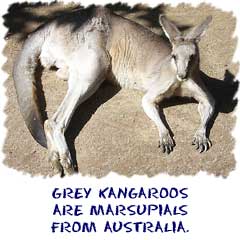
Grey kangaroos are found in Australia

MAMMALS WITH EGGS

Monotremes were the first mammals. How do scientists know? They actually lay eggs. Monotremes are more closely related to reptiles than any other mammal. They have not yet evolved a way to have their babies live. Examples of monotremes are a duck-billed platypus and the spiny anteater.

MAMMALS WITH POUCHES

There are many more marsupials than monotremes. Kangaroos, koalas, bandicoots, and possums. You’ll find a lot of them in Australia. Australia is an island continent. Because of its isolation, placental mammals didn’t take hold in their ecosystems. Australia is like a mammalian time capsule. Marsupials are special mammals that give birth to their young live, but the babies mature in pouches. While they are in the pouch they suckle on the mother’s milk for nourishment.

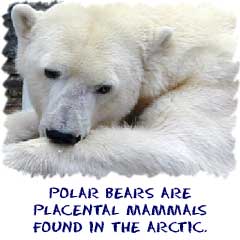
Polar bears are placental mammals found in the arctic

LIKE YOU AND ME

Placental mammals are the dominant form of mammal on the planet. Placental mammals deliver their young live and ready for action. Although the babies might still need some work, much of the basic development is done inside of the female’s placenta. When the baby is born, it still needs some raising and education. Mammalian mothers will usually stick around and help in that learning process. There are no pouches. The baby must walk or be carried.

Placental mammals are everywhere, even in the oceans. A group called cetaceans includes dolphins and whales. They are mammals that evolved and returned to the ocean. They still breathe air and even have tiny hairs like other mammals, but they live their whole lives in the water.


VERTEBRATES

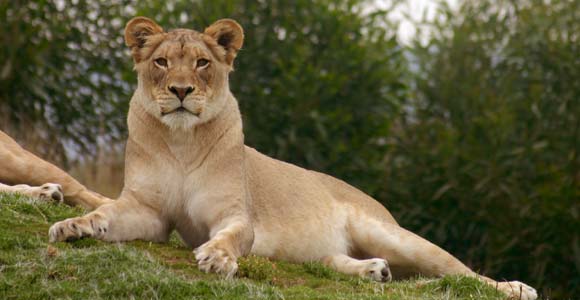
Resting Lions


While there aren’t that many species of vertebrates, we know you can name dozens of them. There are about 57,000 known species and the subphylum includes fish, amphibians, reptiles, birds, and mammals. There may be a greater number of invertebrate species across the planet, but the vertebrates are the most intelligent and advanced.

What do all of the vertebrate species have in common? They all have a skull and backbone with small bones called vertebrae. While you might not think much of some of your classmates, vertebrates are the most intelligent creatures on Earth. The skull and backbone are designed to protect our advanced nervous systems. The bones could be made of cartilage or calcified bone. Many fish have cartilage for their skeletons while mammals and reptiles have harder bones. Birds have similar bone composition to mammals, but they are hollow and lighter. The lighter bones help them fly.

Examples of mammal species


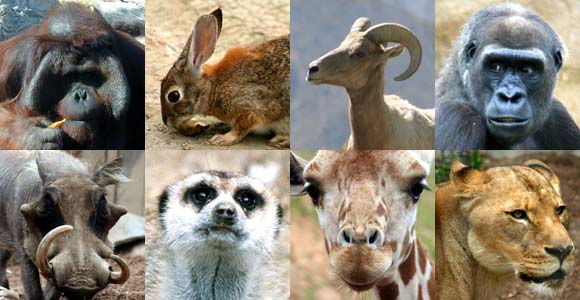
The most advanced vertebrates on Earth are mammals. The class Mammalia includes over 5,000 species that include animals from the platypus to kangaroos to humans. As you can guess from our short list, living mammals come from one of three groups. There are egg-laying mammals, mammals that have pouches to raise their young, and mammals that have placentas. These placental mammals have their young develop inside their bodies before they give birth. Humans are placental mammals.

Even though mammals have a few thousand living species, many more have become extinct. The first mammals appeared in fossils around 250 million years ago. They eventually developed many unique characteristics including control over their body temperature (homeotherms), hair, and seven cervical vertebrae in their necks.

Since mammals can control their body temperature, they can be found across the entire planet. You might find small mice in the hottest deserts and polar bears in the arctic cold. There are also flying mammals that live in trees and caves. There are even groups of mammals that have returned to the oceans of the world. They have developed characteristics that allow them to hold their breath for long periods and fins that make them strong swimmers. Never forget that they still have lungs and always return to the surface for a quick breath of air.

What are genes? What are chromosomes?

Genes
Everything that is alive has genes that determine what kind of creature the living being is. Genes are tiny strings of chemicals that are the microscopic building blocks of life. Genes are, in essence, instruction manuals for each life form.

Genes determine if a living being will be a plant or an animal, and what type of plant or animal the life form will be, down to what color it is and what kind of skin, fur or feathers are on its body. Genes also determine the individual, unique characteristics a living thing has, as well as the personality traits it will possess.

Genes are combinations of four different chemicals called nucleotide bases. The four nucleotides are called adenine, cytosine, guanine and thymine. Scientists simplify these into four initials, A,C, G and T, when they discuss genetic code. The different characteristics of a living thing are determined by the specific combinations of these four chemicals.

Chromosomes
Chromosomes are long strings of gene codes. Some of these coding strings consist of thousands, or hundreds of thousands, of individual genes, all strung together into a string of DNA. Human beings have 23 pairs of chromosomes, but some animals have more. A donkey actually has more pairs of chromosomes than a human being, with a total of 31.

Gene expression refers to how your genetic makeup shows through in your health, personality or character traits. For example, if you have blue eyes, your eye color is the gene expression of that specific genetic code. You might have a particular medical condition because of particular genes, and that medical condition is a result of gene expression.

Cell Division

Your body is composed of more than a billion cells. Cells are continually dying, and new cells are continually being formed. An identical copy of your hereditary material is found in the nucleus of each and every somatic cell. A somatic cell is any cell in the body except for the reproductive cells in the reproductive system.

This genetic blueprint is organized into 46 chapters or parts known as chromosomes. It is estimated that, on average, each chromosome contains between one and two thousand genes. A gene contains the information for making a single protein or RNA product.

Every time a cell divides, each chromosome must be carefully replicated (copied) and then distributed to assure that each daughter cell gets a complete and accurate set of information. Thus, nuclear division includes successive processes of chromosome replication, separation, and distribution (Figure 1).


Figure 1: Chromosome Replication & Division


DNA synthesis occurs in the nucleus, producing an exact replica of every chromosome. A chromosome can be thought of as a very long DNA double helix. During replication, the double helix opens up and a new complementary strand is synthesized along each parent strand (Figure 2). This results in two identical DNA helices, each containing one original parent strand and one newly synthesized strand.

Figure 2: DNA Replicating


DNA synthesis occurs during the S phase of interphase. Each cell goes through a regular life cycle, similar to the cycle of life in humans. Where we might call our stages infancy, childhood, adolescence, young adult, adult, and senior, the major cell stages are interphase, mitosis, and cytokinesis. Interphase is subdivided into G1 (growth 1), S (synthesis), and G2 (growth 2), and mitosis is divided into P (prophase), PM (prometaphase), M (metaphase), A (anaphase), and T (telophase). This is shown in Figure 3.

Figure 3: Cell Cycle


Another way to illustrate this cycle is shown in Figure 4.


Figure 4: Cell Division


Click here to learn more about chromosomes.

Animals vs Plant Cells

CELL STRUCTURE AND FUNCTIONS

CELL STRUCTURE AND FUNCTIONS

This interactive map of plant and animal cells makes it easier to learn the different organelles.

Cell structure and functions

1.- THE CELL


Cells are the Starting Point

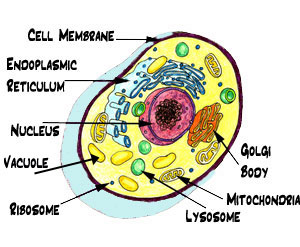
Structure of generic animal cellAll living organisms on Earth are divided in pieces called cells. There are smaller pieces to cells that include proteins and organelles. There are also larger pieces called tissues and systems. Cells are small compartments that hold all of the biological equipment necessary to keep an organism alive and successful on Earth.

A main purpose of a cell is to organize. Cells hold a variety of pieces and each cell has a different set of functions. It is easier for an organism to grow and survive when cells are present. If you were only made of one cell, you would only be able to grow to a certain size. You don’t find single cells that are as large as a cow. Also, if you were only one cell you couldn’t have a nervous system, no muscles for movement, and using the internet would be out of the question. The trillions of cells in your body make your life possible.

One Name, Many Types


Animal and plant cells

There are many types of cells. In biology class, you will usually work with plant-like cells and animal-like cells. We say animal-like because an animal type of cell could be anything from a tiny microorganism to a nerve cell in your brain. Plant cells are easier to identify because they have a protective structure called a cell wall made of cellulose. Plants have the wall; animals do not. Plants also have organelles like the chloroplast (the things that make them green) or large water-filled vacuoles.

Different types of animal cells

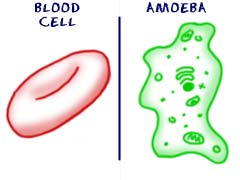
We said that there are many types of cells. Cells are unique to each type of organism. Humans may have hundreds of types of cells. Some cells are used to carry oxygen (O2) through the blood (red blood cells) and others might be specific to the heart. If you look at very simple organisms, you will discover cells that have no defined nucleus (prokaryotes) and other cells that have hundreds of nuclei (multinucleated). The thing they all have in common is that they are compartments surrounded by some type of membrane.


CELL NUCLEUS - Commanding the Cell

The cell nucleus acts like the brain of the cell. It helps control eating, movement, and reproduction. If it happens in a cell, chances are the nucleus knows about it. The nucleus is not always in the center of the cell. It will be a big dark spot somewhere in the middle of all of the cytoplasm (cytosol). You probably won’t find it near the edge of a cell because that might be a dangerous place for the nucleus to be. If you don’t remember, the cytoplasm is the fluid that fills cells.


CELL FUNCTIONS

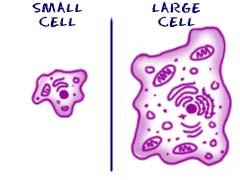
Cells come in many sizesAll cells have a purpose. If they don’t do anything productive, they are not needed anymore. In the big picture, a cell’s purpose is much more important than acting as small organizational pieces. They had their purpose long before they started working together in groups and building more advanced organisms. When alone, a cell’s main purpose is to survive.

Even if you were a single cell, you would have a purpose. You would have to survive. You would be moving around (probably in a liquid) and just trying to stay alive. You would have all of your pieces inside of you. If you were missing a piece you needed to survive, you would die. Scientists call those pieces organelles. Organelles are groups of complex molecules that help a cell survive.

All Cells are not Created Equal

Cells have different components.In the same way that cells survive in different ways; all cells have different types and amounts of organelles. The larger a cell becomes the more organelles it will need. It makes sense if you think about it. If you are a big cell, you will need to eat more than a little cell. You will also need to convert that food into energy. A larger cell would need to eat more and may wind up having more mitochondria to process that food into energy.

While they might have a purpose, more advanced cells have a difficult time surviving on their own. A cell from your brain could not survive in a Petri dish for long. It doesn’t have the right pieces to live on its own. It does have the ability to transmit electrical systems around your body. An amoeba could survive in a dish forever, thrive, and reproduce. On the other hand, that amoeba will never help you transmit electrical impulses. The brain cell is far more advanced and has specific abilities and organelles. Simpler cells have a better chance of surviving on their own while complex cells can accomplish tasks that are more advanced.


MITOSIS - WHEN CELLS SPLIT APART

Eventually cells need to duplicate. There are two main methods of replication, mitosis and meiosis. This tutorial will talk about mitosis.

The big idea to remember is that mitosis is the simple duplication of a cell and all of its parts. It duplicates its DNA and the two new cells (daughter cells) have the same pieces and genetic code. Two identical copies come from one original. Start with one; get two that are the same. You get the idea.

Beyond the idea that two identical cells are created, there are certain steps in the process. There are five (5) basic phases in the life-cycle of a cell. You should remember the term PMATI (pronounced PeeMahtEee). PMATI is the acronym for the phases of a cell’s existence. It breaks down to.

PROPHASE - METAPHASE - ANAPHASE - TELOPHASE - INTERPHASE

Prophase and MetaphaseWe suppose it would be good to know what happens during those phases. Always remember - PMATI!

THE PHASES

Prophase: A cell gets the idea that it is time to divide. First, it has to get everything ready. You need to duplicate DNA, get certain pieces in the right position (centrioles), and generally prepare the cell for the process of mitotic division.

Metaphase: Now all of the pieces are aligning themselves for the big split. The DNA lines up along a central axis and the centrioles send out specialized tubules that connect to the DNA. The DNA (chromatin) has now condensed into chromosomes. Two strands of a chromosome are connected at the center with something called a centromere. The tubules actually connect to the centromere, not the DNA.

Anaphase and TelophaseAnaphase: Here we go! The separation begins. Half of the chromosomes are pulled to one side of the cell; half go the other way. When the chromosomes get to the side of the cell, it’s time to move on to telophase.

Telophase: Now the division is finishing up. This is the time when the cell membrane closes in and splits the cell into two pieces. You have two separate cells each with half of the original DNA.

Interphase: This is the normal state of a cell. We suppose that when it comes to cell division, you could call this the resting state. It’s just going about its daily business of surviving and making sure it has all of the nutrients and energy it needs. It is also getting ready for another division that will happen one day. It is duplicating its nucleic acids, so when it’s time for prophase again, all the pieces are there.

1st term Project: THE HUMAN BODY

1st term Project: THE HUMAN BODY

Now you know the title of the first term project.

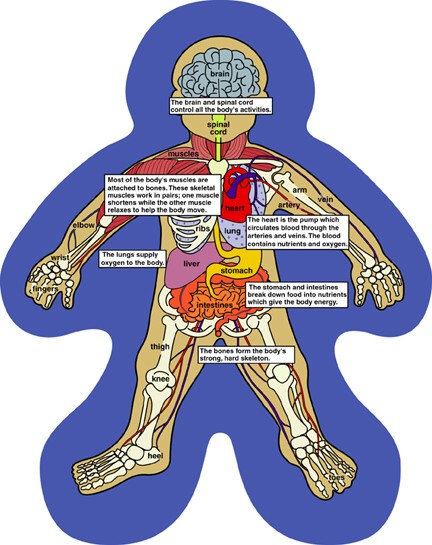
We’re learning A BIT MORE about the Human Body and things related to it.

Click here to start reviewing some facts about the Human Body, and don’t forget to take mental notes of all the new information you find.

SCIENCE THIS YEAR

SCIENCE THIS YEAR

As you all know, this year we are not using books in Science, we’re working on projects instead.

This year, more than ever, we are ALL working and helping finding information about the topics we are going to learn (Human Body, Technology, History and Geography).

Remember that when you learn by doing you achieve much more knowledge than when you only learn by listening (or pretend to listen). That is because in the first case you are an active part of your learning process, you may have to choose what you want to learn, you may have to investigate, you may have to hear (and respect) other ideas and you may have to present your own ones.

Bearing this in mind I encourage all of you to work hard this year and to enjoy doing it.

TEST YOURSELF

TEST YOURSELF

Prepare yourself for the Initial Evaluation we’ll have next week.

You’ll find quite a lot of online quizzes to help you.

MULTIPLE CHOICE QUESTIONS

WORKING TOGETHER!!


This is the aim I’d like to fulfill along this new school year.

The spirit shown in this video made by a school in Tenerife is a good example to follow. We all can do great things together!!

Hope we really keep this team spirit and we learn lots of new things together!!

BACK TO SCHOOL

BACK TO SCHOOL

Now that September is here, IT’S SCHOOL TIME AGAIN!!!

You’re probably feeling excited and maybe a little sad that summer is over. Some kids feel nervous or a little scared on the first day of school because of all the new things: new teachers, new friends, new knowledge. Luckily, these "new" worries only stick around for a little while.

Let’s find out more about going back to school.

WARNING - AVISO

ESTE MENSAJE ES PARA TODOS LOS USUARIOS DE NUESTRO BLOG Y PARA VUESTROS PADRES.

NUESTRO BLOG HA SIDO OBJETO DE SABOTAJE EXTERNO POR PARTE DE ALGÚN TIPO DE HACKER INFORMÁTICO QUE HA CAMBIADO FOTOS PUBLICADAS PARA REEMPLAZARLAS POR FOTOS O COMENTARIOS OBSCENOS.

ESPERAMOS QUE ESTO NO SE REPITA, PERO SI SUCEDE, POR FAVOR, ENTENDED QUE ESTAMOS TRABAJANDO PARA QUE NO OCURRA Y PARA SUBSANARLO LO ANTES POSIBLE.

GRACIAS A TODOS POR VUESTRO APOYO Y NO DUDÉIS EN SEGUIR VISITÁNDONOS Y HACIENDO COMENTARIOS POSITIVOS, QUE ES LO QUE NOS ANIMA A SEGUIR.

BESITOS A TODOS. Guiño

3er term SPELLING BEE

Last Tuesday we had the 3er and last Spelling Bee of this school year.

Once again it was a wonderful experience.

After a previous selection that took part in every classroom, we had a group of 20 participants and at the end our true winners were: Sofía Duque Elbar (3rd), Naiara Molina Díaz (2nd) and Sergio Benítez Rodríguez (1st).

This time we also had a couple of Spelling Dictionaries: Alba González Martín and Pablo Luis de Pablo Carrión who did a great job helping all the contestants.

CONGRATULATIONS TO ALL OF YOU!!!!

TALENT SHOW

El pasado lunes 21 de junio tuvo lugar el 1er certamen de TALENT SHOW en nuestro colegio.

El objetivo de este festival es que los alumnos de 5º y 6º en particular y la comunidad educativa del centro en general, participen de una actividad lúdica en la que poder mostrar nuestro talento en un escenario delante de nuestros compañeros.

Bajo el lema ¡¡TÚ TIENES UN TALENTO!! pudimos comprobar que en nuestro colegio hay talento y habilidades a raudales y que entre todos somos capaces de preparar un fin de curso divertido, dinámico y muy educativo.

En esta primera convocatoria hemos contado con 54 alumnos participantes divididos en 22 grupos que nos deleitaron con actuaciones de lo más diversas: canto, baile, música instrumental, deletreo, poesía y taekwondo. El broche final lo pusieron tres grupos de profesores bailando, cantando y haciendo malabares.

El jurado, formado por representantes del Claustro de Profesores, un representante del Equipo Directivo, un representante del AMPA y un representante de la Escuela Municipal de Teatro, lo tuvo muy difícil para elegir a los ganadores y repartir los premios otorgados por el Ayuntamiento de nuestro municipio.

Esta 1ª edición del TALENT SHOW ha sido todo un éxito, por lo que pensamos repetir en cursos próximos.

¡Gracias a todos los participantes por vuestro entusiasmo y al público por su colaboración!!!

Hoy (lunes 21 de junio) empieza el verano en el hemisfério norte


  Este lunes, 21 de junio de 2010 a las 13.28 hora oficial peninsular en el Hemisferio Norte, se inicia la estación más larga del año desde hace algunos siglos, el verano, que durará 93 días y 15 horas, según lo acordado en el convenio astronómico que recoge el Observatorio Astronómico Nacional (OAN), del Ministerio de Fomento.

   El inicio de las estaciones viene dado por aquellos instantes en que la Tierra se encuentra en unas determinadas posiciones en su órbita alrededor del Sol. En el caso del verano, esta posición se da en el punto de la eclíptica en el que el Sol alcanza su posición más boreal.

   El día que esto sucede, el Sol alcanza su máxima declinación norte y permanece casi sin moverse durante varios días, y por eso, a esta circunstancia se la llama también solsticio o ’sol quieto’ de verano. En este instante en el Hemisferio sur se inicia el invierno.

   El día del solsticio de verano corresponde al de mayor duración del año entre la salida y la puesta del Sol en un lugar dado. Así, el próximo día 21 de junio va a ser el día de mayor duración, y por ejemplo, en Madrid esta duración será de 15 horas y tres minutos, a comparar con las nueve horas y 17 minutos que durará el día más corto (el 22 de diciembre).

   Esta diferencia de casi seis horas depende de la latitud del lugar, siendo nula en el Ecuador y siendo extrema (24 horas) por encima del Círculo polar ártico. Es precisamente por encima del Círculo polar boreal donde algunos días al año (alrededor del 21 de junio) se da el fenómeno del Sol de medianoche, en que el astro rey es visible por encima del horizonte durante las 24 horas del día. (En la Antártida tiene lugar alrededor del 21 de diciembre)

   Alrededor de esta fecha se encuentran el día en que el Sol sale más pronto y aquél en el que se pone más tarde. Un hecho circunstancial no relacionado con las estaciones se da también en esta época: el día del ’afelio’, es decir, el día en que el Sol y la Tierra están más alejados entre sí a lo largo del año.

LA TIERRA SE MUEVE MÁS LENTA

   Es este mayor alejamiento al Sol la causa de que la Tierra se mueva más lentamente a lo largo de su órbita elíptica durante el verano (según la conocida como tercera Ley de Kepler) y por lo tanto la duración de esta estación sea mayor.

   Además, el día en que el Sol sale más pronto es el 14 de junio, mientras que el día en que se pone más tarde es el 27 de junio. Por estas fechas se da también el máximo alejamiento anual (afelio) entre la Tierra y el Sol. En esta ocasión, se dará el próximo día 6 de julio, siendo la distancia de algo más de 152 millones de kilómetros, unos cinco millones más que a principios de enero, cuando la distancia al Sol alcanza su mínimo anual.

   Por otro lado, la actividad del Sol se caracteriza por la presencia en su superficie de manchas, fulguraciones y protuberancias, y en la Tierra, se aprecia en alteraciones en la propagación de las ondas de radio y en una mayor presencia de auroras polares. Esta actividad sigue un periodo de aproximadamente once años, y está asociada al ciclo magnético del Sol.

   A lo largo del verano habrá dos eclipses, aunque ninguno de ellos será visible en España tendrán lugar el día 26 de junio uno parcial de Luna, que será visible en el sureste asiático, Australia, regiones del Pacífico y América y que vendrá acompañado de uno total de Sol, que se dará dos semanas más tarde, el 11 de julio, y será visible en el Océano Pacífico Sur y el extremo meridional de Sudamérica.

   Durante el mes de julio de 2010 se producirán dos pasos de Júpiter por el Ecuador Celeste; el 8 de julio Júpiter cruza el Ecuador de sur a norte y el 31 de julio el cruce será de norte a sur. Habrá un tercer paso (de sur a norte) que se producirá el 5 de febrero de 2011.

FENÓMENOS ASTRONÓMICOS

   La primera Luna llena del verano se dará el 26 de junio, dándose las siguientes 29 ó 30 días después y habrá otras el 26 de julio y el 24 de agosto. Por otro lado, en cuanto a la visibilidad de los planetas, como luceros matutinos se podrá observar a Júpiter y a Urano, que pasarán a ser visibles durante toda la noche en septiembre y agosto respectivamente. Al atardecer se verán Venus, Marte y Saturno.

   Concretamente, el día 20 de septiembre se producirá el máximo acercamiento anual de Júpiter a la Tierra. Además, las lluvias de meteoros más intensas del verano son las ’delta Acuáridas’, cuyo máximo ritmo se da alrededor del 30 de julio, y la más famosa del verano, la de ’Las Perseidas’, cuyo máximo se da alrededor del 12 de agosto.

CONSTELACIONES

   En cuanto a las agrupaciones ficticias de estrellas conocidas como constelaciones, alrededor de la estrella Polar se verán a lo largo de la noche Casiopea, Cefeo, el Cisne, el Dragón y las dos Osas. De este a sur a oeste se verán Pegaso, el Aguila, la Corona Boreal y la Cabellera de Berenice.

   Igualmente, cerca del horizonte se verán a lo largo de la noche algunas de las constelaciones zodiacales, de la Virgen a Acuario, esta última ya cerca del amanecer. Entre las estrellas más brillantes visibles en esta época destacan las que constituyen al ’triángulo veraniego’: Altair (en el Aguila), Deneb (en el Cisne) y Vega (en la Lira).

II Concurso de Narración y de Recitado de Poesía


Este año, la Consejería de Educación ha convocado el II Concurso de Narración y de Recitado de Poesía para alumnos de quinto curso de Educación Primaria escolarizados en centros docentes públicos y privados de la Comunidad de Madrid, que trata de estimular el esfuerzo de los centros educativos, los profesores y los alumnos en el nivel de expresión oral y escrita. Esta segunda convocatoria se ha llevado a cabo en los meses de abril, mayo y junio de 2010.

Ha habido dos modalidades, una de narración y otra de recitado de poesía. Cada centro ha podido seleccionar un máximo de dos alumnos para cada modalidad y se ha celebrado una fase territorial y una final. En la modalidad de narración, el alumno ha dispuesto de una hora para realizar una composición escrita.

En la modalidad de recitado de poesía el alumno ha tenido que aprender de memoria y recitar tres poesías de un repertorio obligatorio para la fase territorial. Para la fase final, a estas tres poesías se ha sumado una cuarta elegida libremente por el alumno.

El curso pasado nuestro colegio salío triunfante en la primera convocatoría del concurso, siendo el ganador de la modalidad de narrativa vuestro compañero de 6ºD  David Sanz.

Este año seguimos de enhorabuena, ya que  Lucía Guerra sido una de las triufadoras en la modalidad de narrativa y Naiara Molina ha conseguido una mención honorífica en la modalidad de recitado de poesía.


¡¡¡¡¡ENHORABUENA A LAS DOS!!!!!


INVENTIONS IN HISTORY


A website with a timeline of historic and technological inventions and events

PREHISTORIC ART and HISTORY

PREHISTORIC ART and HISTORY

Useful websites to learn more about the Prehistoric times.

Hope you like them.


A virtual tour of the cave paintings

Cave Art (+ other important pieces of art in history)

An online documentary about the story of our origins


Unit 14: DIFFICULT WORDS

Archaelogy: the study of the past, based on objects or parts of buildings that are found in the ground.

Excavation: the dig in the ground to look for old objects or buildings that have been buried for a long time, to find something.

Tool: a piece of equipment such as a hammer, that you hold in your hand(s) and use to do a particular job.

Weapon: an object which is used for fighting or for killing people, such as a spear, sword, etc.

Fabric: cloth or soft material that is used for making clothes, curtains, etc.

To last: to continue for a period of time.

Shelters: protection from danger or bad weather; a small building that gives protection, for example from bad weather or attack.

Branches: one of the main parts of a tree that grows out of the thick central part; a part of a government or other large organization that deals with one particular aspect of its work.

Sparks: a very small bright piece of burning material; a flash of light that is caused by electricity.

To slide: to move or make something move smoothly along a surface.

Plough: a large farm tool which is pulled by a tractor or by an animal.

Sedentary: involving a lot of sitting down; not active.