Blogia

CLASS OF 2010-2011!!!

23th March: WORLD METEOROLOGICAL DAY

23th March: WORLD METEOROLOGICAL DAY

On March 23 World Metereological Day is celebrated, it commemorates the foundation of World Meteorological Organization (WMO) in 1950. This specialized agency of the United Nations arose in order to study the time, to analyze the climate change and to distribute the resources of the water. This year celebrates its annual 60 and has the following motto: "60 years to the service of your safety and well-being".

I offer you a web pages selection with contents related to the time, the climate change and the water saving:
Weather Wiz Kids
Web Weather for Kids
One Word Net’s Kids Channel
US Environmental Protection Agency

And more crafts and activities:
About.com
Enchanted Learning
Family Fun Go

SUPERSABER

SUPERSABER

¡Hola chic@s!

Vamos a hacer un poco de cálculo mental y a repasar nuestros conocimientos de ciencias junto al profesor TIC, el señor PI, el visitante, Estrella, Bombi, Sabueso y el malo Malasombra, pero ¡¡cuidado, tienes que ser muy rápido y acertar tus respuestas...!!

Pinchad en el siguiente enlace para aprender, disfrutar y pasar un buen rato. SuperSaber


HAPPY FATHER'S DAY!!

HAPPY FATHER'S DAY!!

Father’s Day in Spain is celebrated on March 19th. Fathers are as important as mothers. I found a couple of quotes about fathers that I wrote above, that sums up, in a very simple way, what fathers represent in our lives.

We will only start agreeing with our father and giving him credit (and actually paying attention to his long sermons) after we get older ourselves and start living what he lived before. There’s a reason for the saying “voice of experience”. Fathers actively participate and are highly involved in our lives. They protect, support and love us all the way! It’s time for us to show a bit of gratitude in return. Not that a gift once a year will do the trick, but remembering your dad on Father’s Day is very symbolic of what he means to you.


“The older I get, the smarter my father seems to get”- Tim Russert

“There is more to fathers than meets the eye”- Margaret Atwood


NAIARA (5ºC) recommends us:

Naiara has found a couple of interesting websites in which you can learn a bit more about Geography by playing educational games in flash.

Interactive mapsRisa

SAINT PATRICK'S DAY


This is a nice a cartoon video about the history of the boy and man who became Saint Patrick, the patron of Ireland, that will help you to learn a bit more about him.

Enjoy it!!

The Known Universe


Hace unas semanas, el Museo Americano de Historia Natural colgó en la red este espectacular vídeo, una reconstrucción informática que muestra un "viaje" desde la superficie de la Tierra hasta los límites del universo conocido.


Desde su publicación, casi dos millones de personas lo han visto ya en la web del museo, pero en España este excepcional trabajo sigue siendo prácticamente desconocido.


Lo que hace que este vídeo sea único y diferente a la mayoría de los que se han hecho hasta ahora es que todo lo que en él aparece está basado en datos reales. Es decir, que no se trata de un vídeo "artístico" realizado según simples criterios estéticos, sino de una auténtica reconstrucción, pieza a pieza, de todo lo que sabemos sobre el universo en que vivimos.


Todo, desde las trayectorias de los satélites que orbitan la Tierra, hasta la posición de todas las estrellas, galaxias o lejanísimos quasares, está basado exactamente en los datos que tenemos sobre cada uno de esos objetos. O para ser más precisos, en los datos del Sloan Digital Sky Survey, que componen la que quizá sea la visión más completa del universo de que disponemos hasta el momento.


A pesar de todo, y debido a la posición geográfica en la que se encuentra el telescopio de dos metros y medio del Apache Point Observatory, en Nuevo México, que es el que utiliza el Sloan Digital Sky Survey, existen zonas "oscuras", es decir, áreas del universo que el telescopio, físicamente, no puede observar. Por eso, en el vídeo, la distribución de las galaxias observadas tiene la forma de dos conos unidos por la punta (el punto de unión es la Tierra ), y el resto aparece en negro.


En total, el trabajo comprende casi un millón de galaxias y más de 120.000 quasares. El viaje, que comienza en el Himalaya, termina en el límite mismo de lo que podemos observar con los instrumentos más potentes de que disponemos, los ecos del Big Bang, a 13.700 millones de años luz de distancia, y sirve para que todos nos demos cuenta, de una forma directa y visual, de lo insignificantemente pequeño que es nuestro mundo, incluso nuestra galaxia, si se compara con todo lo que hay "ahí fuera"...

Enjoy it!!

8th March: International Women's Day


International Women’s Day (IWD) is marked on March 8 every year. It is a major day of global celebration for the economic, political and social achievements of women.

As every March 8 today we commemorate the International Day of The Women. On this day there are remembered of the struggles of hundreds of women who have left their lives for the conquest of their labor rights, but especially for the recognition and the respect inside the society.

This beautiful song and these flowers is our tribute to all the women in the world.


ALBA (5ºC) recommends us:

Your classmate has found games to learn a bit more about energy and she wants to share them with you.

Hope you like them as much as she did!!

Energy gamesRisa


Unit 8: DIFFICULT WORDS

Oven: the part of a cooker that has a door. You put things inside an oven to cook them.

Solar panel: a device which is used to convert energy contained within the suns rays into electricity.

Isolated: alone or apart from other people or things.

Windmill: a tall building or structure with sails.

Sail: a large piece of strong material that is fixed onto a ship or boat

Wax: a substance made from fat or oil that melts easily and is used for making candles, polish, etc.

Crops: all the grain, fruit, vegetables, etc. of one type that a farmer grows at one time.

Wells: a deep hole in the ground from which water is obtained.

Coal: a type of black mineral that is mined.


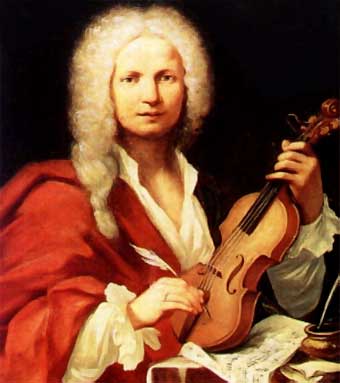
The Four Seasons (Italian: Le quattro stagioni) is a set of four violin concertos by Antonio Vivaldi

These are two of them. Winter, which is about to end (is it???) and Spring, which is going to be here in less than a month.

Hope you like both.

Anniversary of the birth of Antonio Vivaldi


March 4, 1678 - July 28, 1741
Baroque Period

Antonio Lucio Vivaldi was born in Venice, Italy, which is where he spent most of his life. His father taught him to play the violin, and the two would often perform together.

Antonio continued to study and practice the violin, even after he became a priest. He was called the "Red Priest" because of his flaming red hair. However, after a while, his bad asthma kept Antonio from saying Mass.

After that, Vivaldi spent all his time writing music and teaching. He taught at an orphanage for girls, and wrote a lot of music for the girls to play. People came from miles around to hear Vivaldi's talented students perform the beautiful music he had written.

Many people think Vivaldi was the best Italian composer of his time. He wrote concertos, operas, church music and many other compositions. In all, Antonio wrote over 500 concertos. His most famous set of concertos is The Four Seasons.

ENERGY

ENERGY

There are lots of things we can learn about energy that are not in our textbooks. Click on the following link and discover tons of information about energy, their sources, ways of saving energy and games. The games and activities are fantastic!!!


U.S. Energy Information Administration

SPANISH INVENTORS

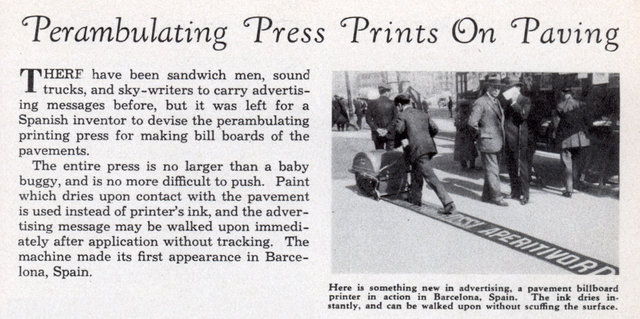
Do you want to know the name of a few Spanish inventors??

Click here to know them learn about their inventions.

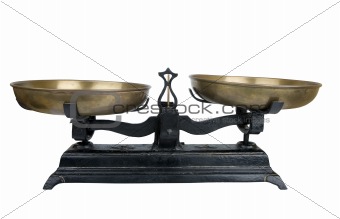
How do we use a weighing scale?

How do we use a weighing scale?

A weighing scale is used to measure the mass of objects. Place an object with an unknown weight on one plate. On the other plate, place objects of a known weight until the two plates are balanced. When the two plates are balanced the weights are equal, indicating the weight of the object.

Celsius and Fahrenheit Conversions Made Simple

Celsius and Fahrenheit Conversions Made Simple

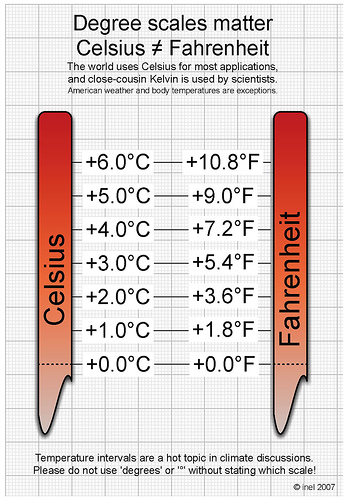
Do you want to know how many degrees Fahrenheit is 20 degrees Celsius???

Find it out applying the formula below and practicing your addition, subtration and multiplication. Now you can try to do this with the temperatures during the whole week (month, year,...).

Converting Celsius to Fahrenheit:

  1. Ask students to think of a temperature in Celsius.
  2. Have them add 40 to that number.
  3. Multiply the new number by 1.8.
  4. Subtract 40.

See example below:

0° Celsius = ?° Fahrenheit
Step #1: 0°C + 40 = 40.
Step #2: 40 x 1.8 = 72.
Step #3: 72 - 40 = 32°F.

Converting Fahrenheit to Celsius:

  1. Think of a temperature in Fahrenheit.
  2. Add 40 to that number.
  3. Multiply the new number by .55555 (a decimal point followed by five 5s).
  4. Subtract 40.

See example below:

32° Fahrenheit = ?° Celsius
Step #1: 32°F + 40 = 72.
Step #2: 72 x .55555 = 39.9996 (round to nearest whole number).
Step #3: 40 - 40 = 0°C.

MULTIPLICA Y DIVIDE POR 10, 100, 1000.


¿¿¿TODAVÍA NO SABES QUÉ HACER CON LOS CEROS AL MULTIPLICAR O DIVIDIR???

Pincha en el siguiente enlace para jugar con la fábrica de los ceros y tener un poco de práctica extra.

DIFFERENT CHANGES

Which changes are reversible and which are irreversible?

See if you can tell.

SCIENCE CLIPS

Have a look at these clips and learn more about science.

Science ages 9 -10

Learn about the experiments that make the properties of solids, liquids and gases change.

A SPECIAL THANK YOU NOTE

A SPECIAL THANK YOU NOTE

The 5th graders want to say THANK YOU to Hazel, Geraldine, Rachael, David, Alana and Jennifer for teaching us to make pancakes and for cooking those yummy ones we ate on Tuesday. You have all been very helpful.

We also want to say GOOD BYE to Hazel who is leaving us to work in Ireland. Thank you Hazel for your help, your dedication and your interest. We’ll miss you!

We love you all!!


Here you have the two recipes to make your own pancakes at home!

Enjoy them!

AMERICAN STYLE

Ingredients Equipment

190g flour large bowl

10g baking powder sieve

6g salt whisk

10g sugar frying pan

295ml milk

1 egg

45g melted butter

Instructions:

  1. Sieve the flour, baking powder, salt and sugar into a large bowl.
  2. Make a well in the centre.
  3. Pour the milk, egg and melted butter into the well.
  4. Whisk it all together.
  5. Heat a lightly oiled pan to medium.
  6. Scoop the batter into the pan.
  7. Flip over the pancake to cook both sides and serve warm.

IRISH STYLE

Ingredients Equipment

110g flour large bowl

2 eggs sieve

200ml milk frying pan

100ml water whisk

2 tablespoons butter small bowl

A pinch of salt fork

Lemon and sugar

Instructions:

  1. Beat the eggs together with a fork in the small bowl. Add the milk and water.
  2. Sieve the flour and salt into the large bowl.
  3. Make a well in the centre of the flour and gradually add the liquid whisking continuously until it is all mixed together well.
  4. Melt the butter on the pan and add it to the batter.
  5. Pour some of the mixture onto a very hot pan.
  6. Flip it over and serve with lemon juice and sugar.

Unit 7: DIFFICULT WORDS

Crane: a large machine with a long metal arm that is used for moving or lifting heavy objects.

Skyscraper: an aextremely tall building.

Titanium: a hard silver-grey metal that is combined with other metals to make strong, light materials that do not easily rust (=react with air over a period of time).

Aluminium: a light silver-coloured metal that is used for making cooking equipment, etc.

To pump: to force a gas or a liquid to go in a particular direction.

Sample: a number of people or things taken from a larger group and used in tests to provide information about the group.

Shape: an example of something that has a particular form.

To heat up: to become or to make something hot or warm.

To cool down: to lower the temperature of something.